Explore the molecules of life, right in your browser
Load any structure from the PDB or AlphaFold, style it, analyse it, draw new molecules, dock ligands to it, and even walk through a cell, with nothing to install and no account.
Load anything
PDB, AlphaFold, SWISS-MODEL and PubChem, or your own PDB, mmCIF and SDF files.
Predict structures
Fold a sequence with ESMFold, or co-fold several chains as one complex.
Style it your way
Ribbon, sticks, spacefill and surface, coloured by chain, B-factor, pLDDT and more.
See interactions
Hydrogen bonds, salt bridges, π-stacking and more, within and between structures.
Analyse
Superposition, alignment, BLAST, Ramachandran plots, pockets and membranes.
Dock and simulate
Vina-style ligand docking, FFT protein–protein docking and coarse-grained dynamics.
Design molecules
Draw molecules atom by atom, with valence, charges and bonds that follow chemistry.
Keep your work
Undo, autosave, sessions, image and 3D-print export, and reports.
Examples
Step-by-step walkthroughs with pictures. Each one ends with a link that opens ProKyria with the structure loaded.
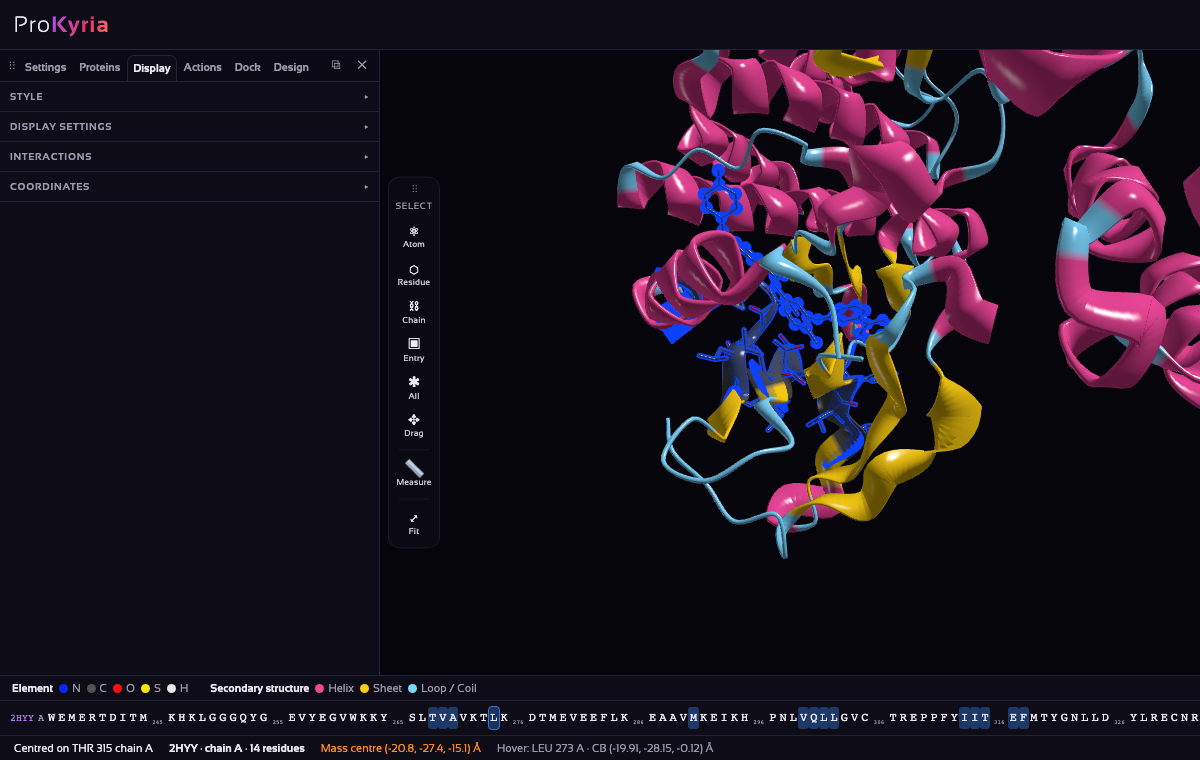 Drug discovery
Find a drug target's pocket and dock its drug
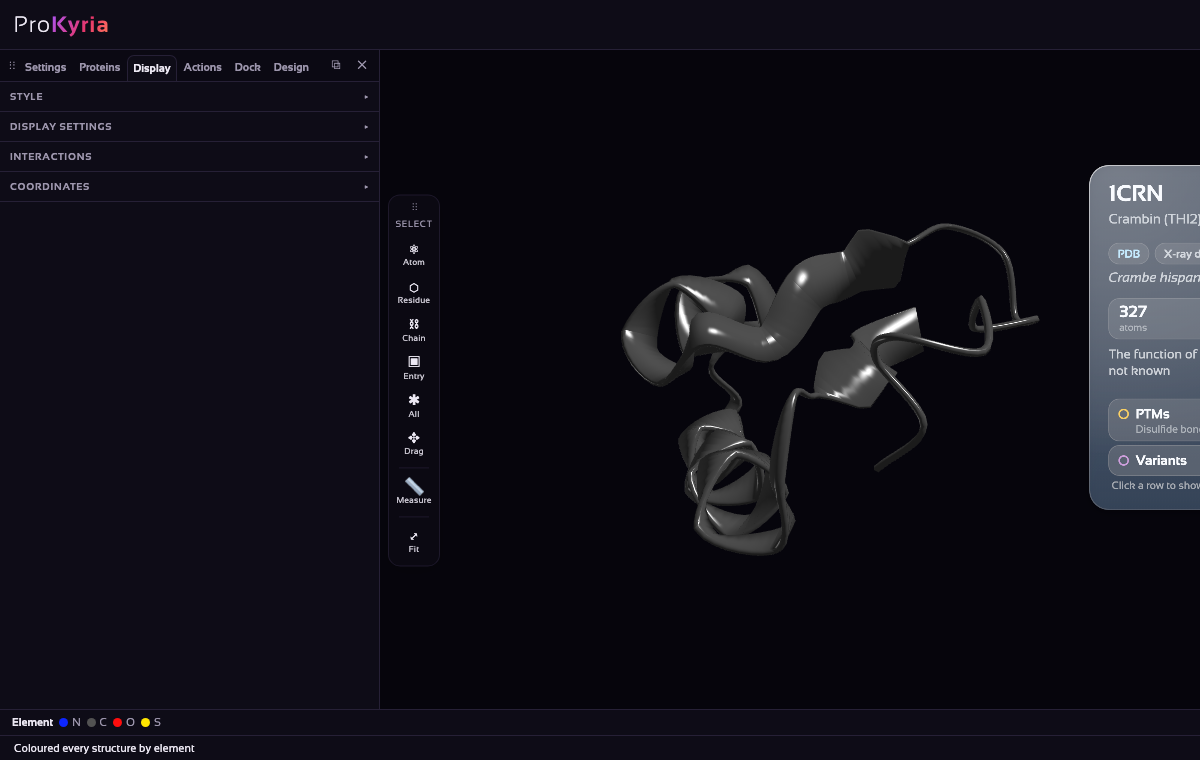 Protein engineering
See how a mutation might destabilise a structure
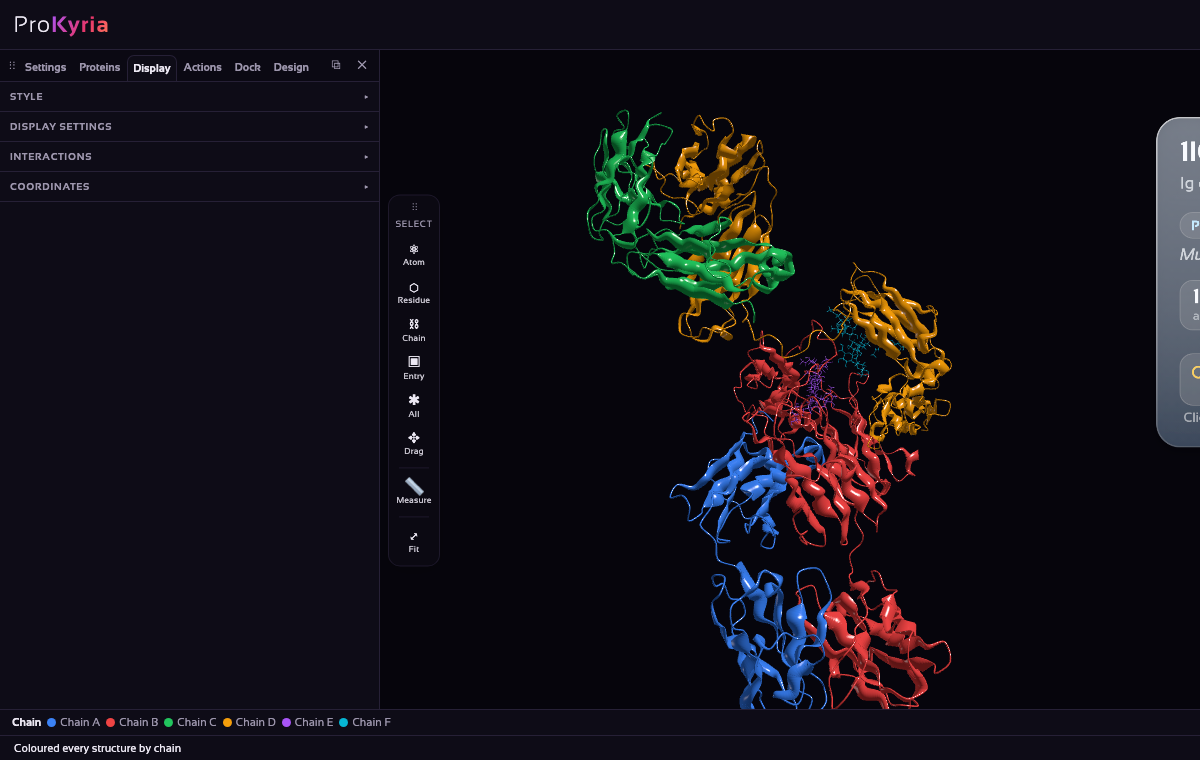 Structure
Explore a multi-chain assembly
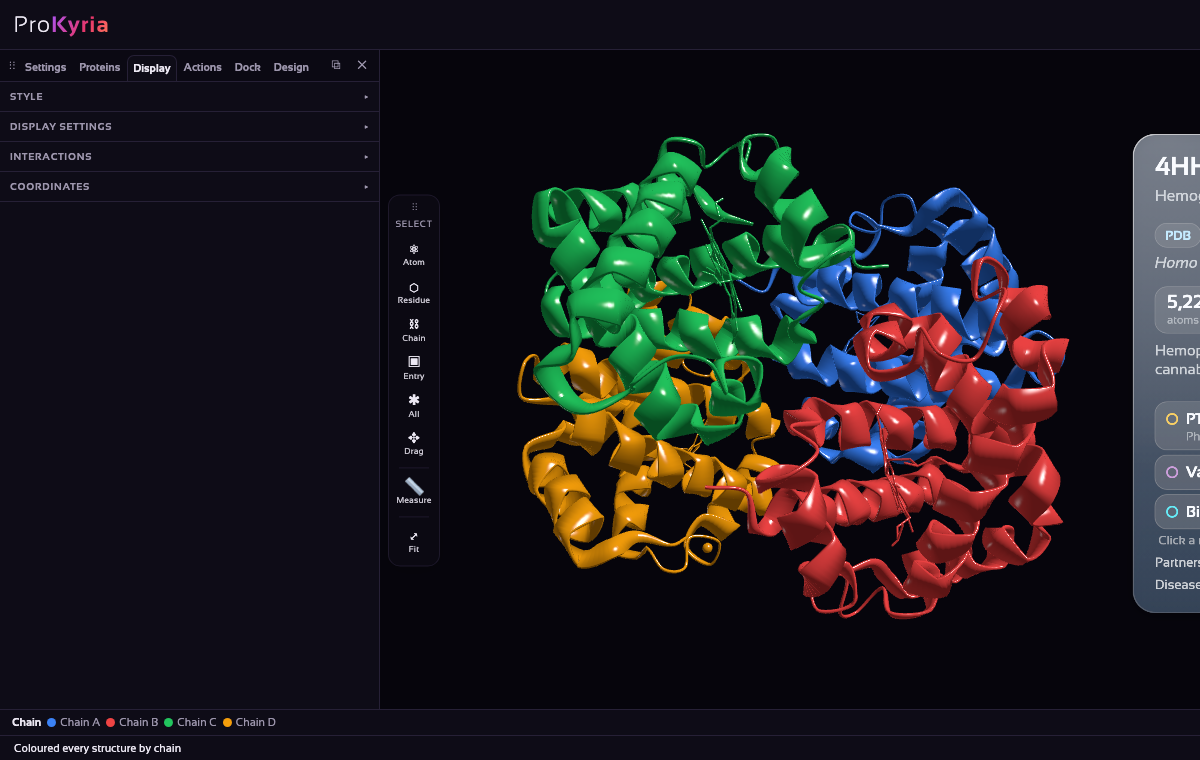 Disease
Trace a protein's disease associations
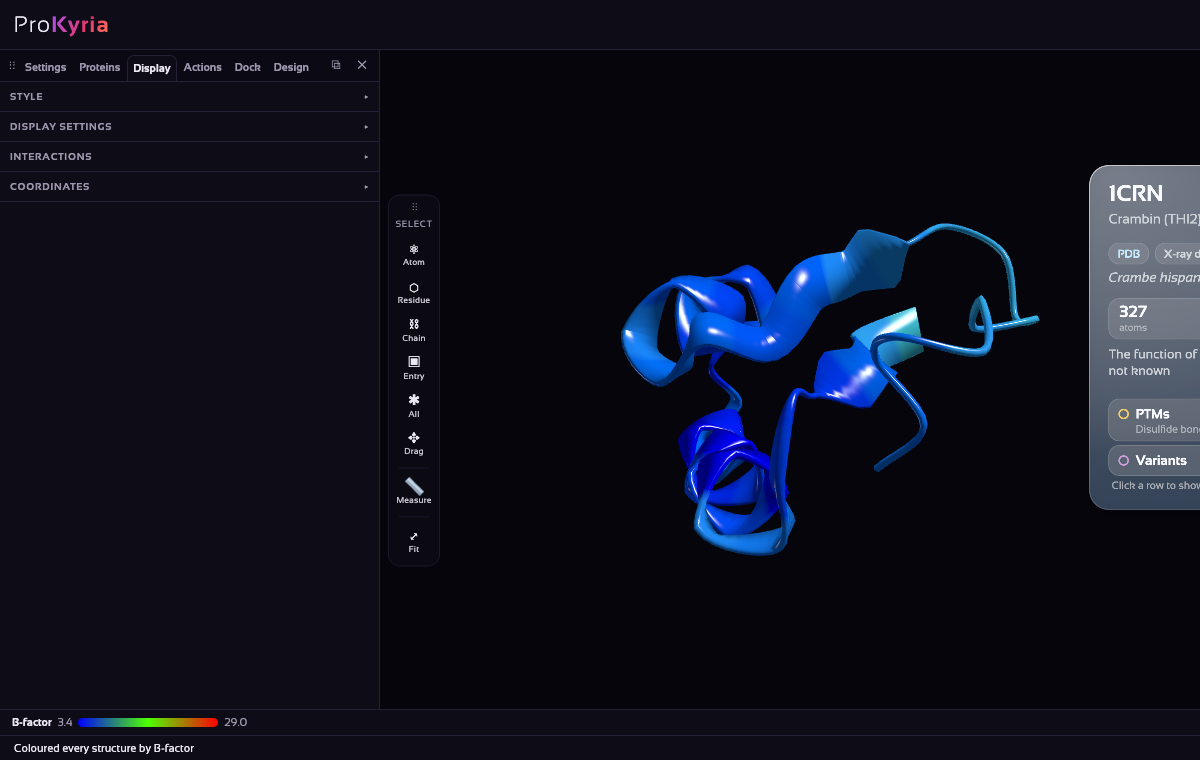 Dynamics
Watch a protein move
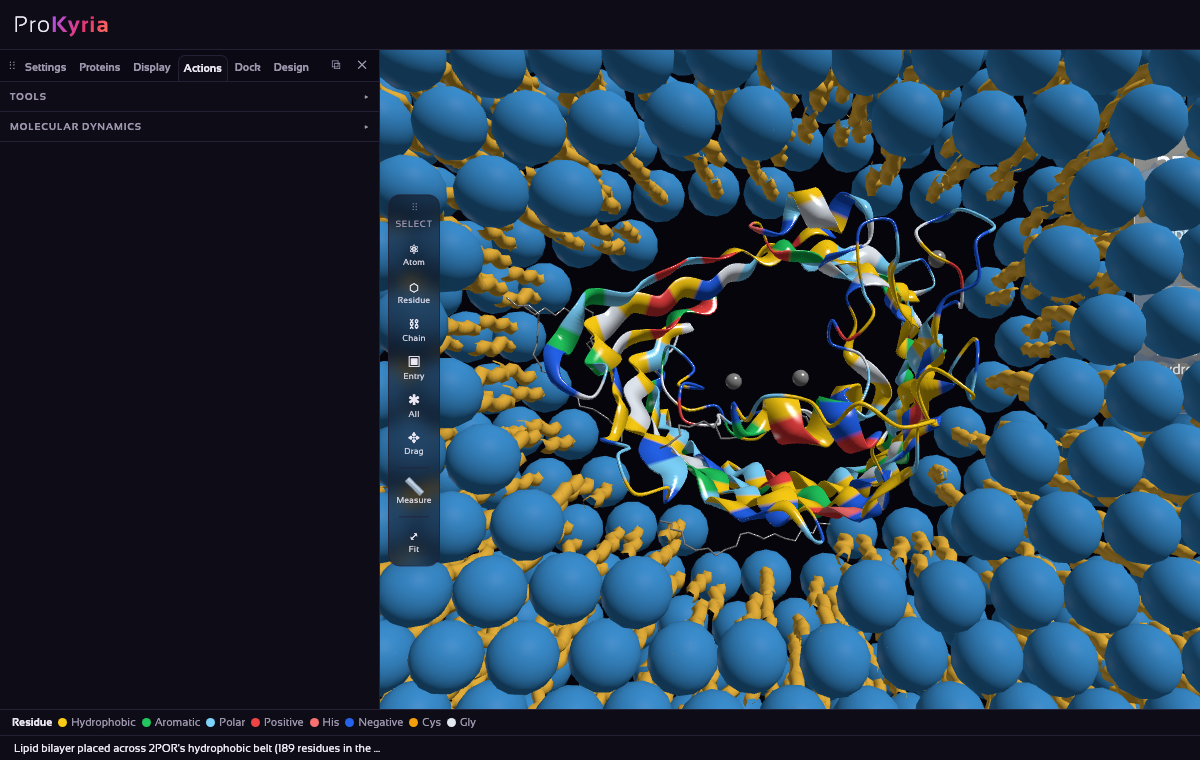 Membranes
Put a channel in a membrane
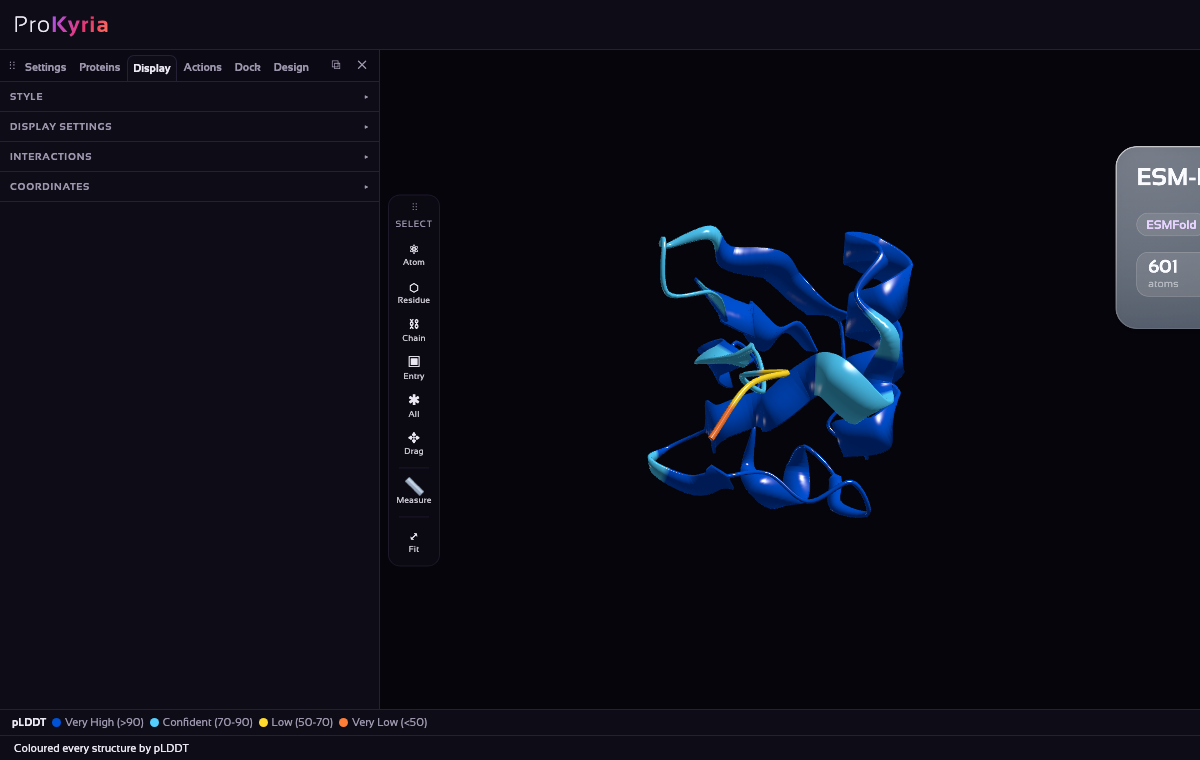 Prediction
Predict a structure from its sequence
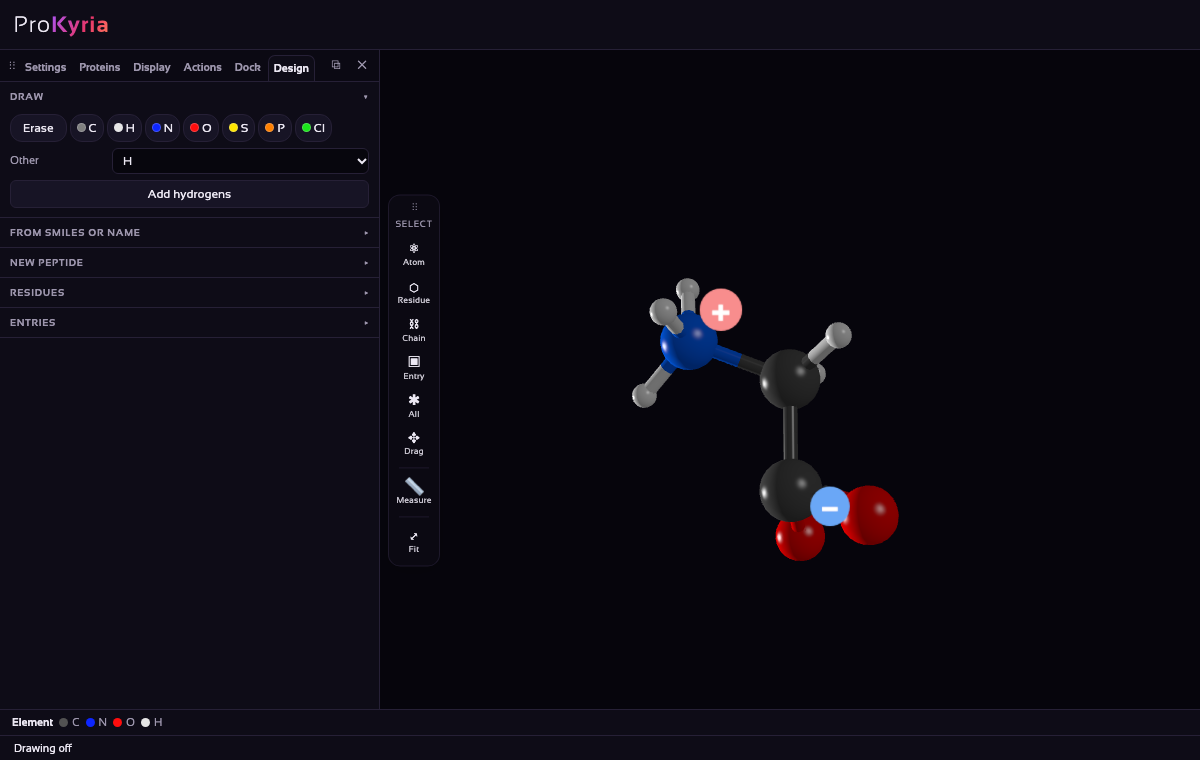 Chemistry
Draw a molecule, atom by atom
PathwaysFollow a protein through its pathway
Pricing
ProKyria is free for academic research and teaching. Companies and other commercial users need a licence: get in touch and we'll find a plan that fits.
Free
for universities, research institutes, students and teaching
- The full program in your browser, with nothing to install
- Loading, styling and analysing structures
- Structure prediction, docking and dynamics
- Sessions, exports and analysis reports
Contact us
for companies and any other commercial use
- Everything in Academic
- A licence for commercial research and development
- Terms and pricing to fit your team
ProKyria is in alpha: features and pricing may change as it develops.
About ProKyria
We build ProKyria for researchers, students and teachers who want to understand a protein's structure quickly, without setting up specialist software first.
Team
Name
Role
One line about this person.
Name
Role
One line about this person.
Name
Role
One line about this person.
Name
Role
One line about this person.
Terms of use
Last updated: 6 October 2026
These terms apply to the ProKyria website and the ProKyria web application (together, "ProKyria"), provided by ProKyria ("we", "us"). By using ProKyria you agree to them. If you don't agree, please don't use it.
1. Using ProKyria
You may use ProKyria free of charge for academic research and teaching at universities, research institutes and schools. Any commercial use, including research and development at or for a company, needs a commercial licence from us; contact us to arrange one. You're responsible for the data you load into it and for how you use the results.
2. Our software and content
ProKyria, including its software, code, algorithms, design and content, is owned by us and protected by copyright and trade-secret law. All rights are reserved. Using ProKyria doesn't give you any ownership of it or any licence beyond using it through this website.
You must not:
- copy, download for reuse, modify, redistribute, sell or publish the ProKyria software or any part of its code;
- reverse engineer, decompile, disassemble or otherwise try to extract its source code, algorithms or methods, except where the law expressly allows this;
- use ProKyria, or anything derived from it, to build a competing product or service;
- remove or change any copyright or proprietary notice;
- use automated tools to scrape the site or put an unreasonable load on it;
- use ProKyria in a way that breaks the law or the terms of the services it connects to.
3. Your data and results
Structures, sequences and files you open stay yours, and the images, models, reports and exports you create are yours to use. Some features send data to outside scientific services; our privacy page explains which ones and when.
4. Third-party data and services
ProKyria shows data from public resources such as the RCSB PDB, AlphaFold DB, UniProt, PubChem and others, and uses third-party software. These belong to their owners and come with their own licences and terms, which apply when you use their data. Some require you to credit them when you publish. See credits & licences.
5. No professional advice
ProKyria is a scientific tool. Its predictions, docking scores, dynamics and other results are computational estimates that can be wrong. They're not medical, clinical or regulatory advice, and shouldn't be relied on for those purposes without independent checking.
6. No warranty
ProKyria is provided "as is" and "as available", without warranties of any kind, to the extent the law allows. We don't promise it will be available without interruption, free of errors, or that its results will be accurate.
7. Limitation of liability
To the extent the law allows, we aren't liable for any indirect or consequential loss, or for loss of data, profit or research time, arising from your use of ProKyria. Nothing in these terms limits liability that can't be limited by law.
8. Changes
We may change ProKyria or these terms at any time. The date at the top shows when the terms were last updated. Continuing to use ProKyria after a change means you accept the new terms.
9. Law
These terms are governed by Danish law. Any dispute about them or about ProKyria is settled by the Danish courts.
10. Contact
Questions about these terms: prokyria@proton.me.
Privacy
Last updated: 6 October 2026
ProKyria runs in your browser. There are no accounts, no cookies, no analytics and no advertising, and this website doesn't collect anything about you.
What stays on your computer
- Settings such as theme, units and display options are kept in your browser's local storage.
- Your work is saved automatically in your browser (IndexedDB) so a reload doesn't lose it. It's kept per browser tab and cleared the next time ProKyria starts after that tab was closed.
- Files you open (PDB, mmCIF, SDF, sessions) are read in your browser and aren't uploaded anywhere.
- Ligands you add to your library are kept in your browser's local storage.
What is sent to other services
Some features fetch data from public scientific services. Your browser contacts them directly, and only when you use the feature:
- RCSB PDB: loading and searching PDB entries, and known ligands.
- AlphaFold DB and SWISS-MODEL: predicted and homology models.
- UniProt: protein information, sequence search and binding sites.
- PubChem: small molecules by name or SMILES.
- Open Targets: known drugs for a protein.
- ESM Metagenomic Atlas (ESMFold): when you predict a structure, the sequence you enter is sent there to be folded.
- EMBL-EBI BLAST: when you run a homology search, the sequence is sent there.
- unpkg: delivers the Three.js 3D library when the program loads.
These services have their own terms and privacy policies. Don't submit sequences you need to keep confidential to ESMFold or BLAST.
Hosting
The website and the program are served by Cloudflare. Like any host, Cloudflare may keep standard access logs (such as IP address and pages requested) to run and protect the service; see Cloudflare's privacy policy.
Contact
Questions about privacy, or about the data this site and the program handle: prokyria@proton.me.
Credits & licences
Data sources
ProKyria fetches structures and annotations from these public resources while you work. Several ask to be credited when you publish results that use them.
| Service | Used for | Licence / terms |
|---|---|---|
| RCSB PDB — file download, Search API, Data API (GraphQL) | Loading PDB entries, keyword search, walk-mode landmark proteins; cell mode's protein crowd (1U8F, 1ALD, 3PGK, 1J6Z, 1UBQ, 1CLL, 1J4N, 1BL8, 4PYP, 2RH1, 3EMN, 1OKC, 1CTS, 1MLD, 1RH5, 5E84, 4EKZ, 3POW, 1KX5, 1WCM, 1AXC, 1CDW, 1HUC, 1LYA, 1NOU, 1LZ1, the human nuclear pore complex 5A9Q built from its assembly operators, and the structures that replace the cell's protein particles near you: the human 80S ribosome 6QZP and mitoribosome 3J9M (mmCIF), bovine ATP synthase 6ZPO, human V-ATPase 7UNF and rat kinesin 3KIN | CC0 1.0 |
| UniProt — REST API | Info cards, known interaction partners (with their protein names, from UniProt's search API), binding-site ligands (Known Ligands), sequence search, AlphaFold accession lookup | CC BY 4.0 |
| IntAct (EMBL-EBI), via UniProt | The interaction partners and their number of experiments — UniProt's interaction comments are IntAct's binary interactions; not called directly | CC BY 4.0 |
| AlphaFold Protein Structure Database — API | Predicted models | CC BY 4.0; EMBL-EBI Terms of Use |
| SWISS-MODEL Repository | Homology models | Models: CC BY-SA 4.0; the website, name and logo remain SIB's |
| ESM Metagenomic Atlas | Folding and co-folding sequences | Data: CC BY 4.0; use under Meta's Open Source Terms |
| PubChem — PUG REST, autocomplete | SMILES and name lookup, ligand library, compound search, 3D conformers | Public domain; NCBI policies |
| Open Targets Platform — GraphQL API | Known Ligands: approved and clinical-stage drugs for the protein's target, with their mechanism of action (drug data from ChEMBL) | Data CC0 1.0; code Apache-2.0 |
| WikiPathways — JSON API and SPARQL endpoint | The Pathways tab: every organism's pathways, the UniProt proteins of a pathway (BridgeDb mappings), the pathways a protein is in; links to the pathway diagrams | CC0 1.0 |
| EMBL-EBI Job Dispatcher — NCBI BLAST+ (REST docs) | Homology search (Advanced > BLAST) | EMBL-EBI Terms of Use; NCBI BLAST+ itself is public domain |
Software & fonts
Third-party software and fonts that ProKyria runs in your browser.
| Component | Used for | Licence |
|---|---|---|
| three.js 0.160.0, incl. addons: OrbitControls, GLTFExporter (Export > 3D Model, .glb) | All 3D rendering; glTF export | MIT |
| Emscripten runtime, compiled into / viewer.wasm | Loading the C++ core in the browser | MIT / University of Illinois NCSA |
| Sansation font by Bernd Montag (Light, Regular, Bold + italics, from google/fonts) | UI typeface | SIL OFL 1.1 |
| LLVM libc++, compiled into viewer.wasm | C++ standard library | Apache-2.0 with LLVM exception |
| musl libc, compiled into viewer.wasm | C standard library (via Emscripten) | MIT |
Scientific methods
Published methods that ProKyria implements in its own code, with the papers to cite and the reference implementations. Nothing is copied from those implementations. Each method has a documentation page.
| Method | Reference | Reference implementation (licence) |
|---|---|---|
| Kabsch superposition, via Horn's quaternion method | Kabsch 1976; Horn 1987 | — |
| Needleman–Wunsch global alignment (linear gap penalty) | Needleman & Wunsch 1970 | — |
| Secondary structure from backbone hydrogen bonds (DSSP's method), for chains the file has no records for | Kabsch & Sander 1983 | DSSP (BSD-2-Clause). Written from the paper; no DSSP code is used. |
| Secondary structure from Cα alone (simplified P-SEA), for Cα-only traces | Labesse et al. 1997 | — |
| Pocket burial test (LIGSITE-style) | Hendlich et al. 1997 | — |
| Alpha-sphere pockets (fpocket-style) | Le Guilloux et al. 2009 | fpocket (MIT) |
| Non-covalent interaction criteria (PLIP-style), including ligand charged groups and aromatic rings perceived from the ligand's geometry | Salentin et al. 2015 | PLIP (GPL-2.0). Only the published criteria are used; copying PLIP code would require GPL. |
| Membrane placement (hydrophobic-slab search) | In the spirit of TmDet (Tusnády et al. 2005) and PPM / OPM | Our own simplified method |
| Small-molecule docking: AutoDock Vina's empirical scoring function (gauss/repulsion/hydrophobic/H-bond terms and weights, torsional normalisation) with a Monte Carlo + BFGS search over a flexible ligand | Trott & Olson 2010 | AutoDock Vina (Apache-2.0). Our code is written from the paper; none of Vina's code is used. |
| X-Score atom types and van der Waals radii (used by the Vina function) | Wang, Lai & Wang 2002 | — |
| Protein–protein docking: FFT shape complementarity | Katchalski-Katzir et al. 1992 | — |
| Electrostatic term for FFT docking (distance-dependent dielectric) | Gabb, Jackson & Sternberg 1997 (FTDock) | FTDock's own code is not used |
| Quasi-uniform rotation sampling (super-Fibonacci spirals) | Alexa 2022, CVPR | — |
| Molecular surface: Gaussian density surface, extracted with Surface Nets | The Gaussian-surface approach of VMD's QuickSurf; Surface Nets: Gibson 1998 | Our own implementation; no VMD or Mol* code |
| Ribbon styles (PyMOL-style cartoon, oval helices, helix cylinders, B-factor putty) | Common molecular-graphics conventions (PyMOL, UCSF ChimeraX) | Our own geometry; no code from either |
| Outline highlight (screen-space "inverted hull" rim) | A standard real-time rendering technique; our own shader | — |
| File formats written by the 3D export: STL, OBJ/MTL, PLY, DXF (R12 polyface meshes), glTF 2.0 | Public format specifications (PLY, OBJ, DXF reference, glTF) | glTF via three.js's GLTFExporter (MIT) |
| Coarse-grained molecular dynamics: elastic network model (one bead per residue at its Cα, harmonic springs within 10 Å of the reference structure) | Tirion 1996; anisotropic network model: Atilgan et al. 2001 | Our own implementation; no ProDy or other ENM code |
| Langevin integrator, BAOAB splitting | Leimkuhler & Matthews 2013 (Appl Math Res Express 2013(1):34–56) | — |
| Superposition that removes rigid-body drift between MD frames (Horn's quaternion method) | Horn 1987 | — |
| Bonding by distance (covalent radii + 0.45 Å) when drawing molecules | The criterion of Open Babel (O'Boyle et al. 2011) and Jmol | Open Babel (GPL-2.0): only the published criterion, no code used |
| Valence and formal-charge rules (normal and maximum valence by element and charge) | Textbook valence rules | — |
| Bond angles for new atoms from VSEPR geometry (tetrahedral, trigonal, linear) | Gillespie & Nyholm 1957 | — |
| Formal charges in molfiles (M CHG, and the atom block's charge column) | The MDL molfile format (Dalby et al. 1992) | — |
| Co-folding with a poly-glycine linker | A common ESMFold/AlphaFold practice (ESM repository) | — |
ProKyria
ProKyria's own software, including its code, algorithms and design, is © 2026 ProKyria. All rights reserved. It is proprietary and confidential, and is made available through this website under the terms of use.
The third-party components above remain the property of their owners and keep their own licences; nothing in ProKyria's terms limits the rights those licences give.
If you publish results made with ProKyria, please credit the data sources you used and cite the methods behind the analyses. Each method page lists its references.
Transparency
Statement of 2026-10-14.
How ProKyria is built
ProKyria is developed with substantial help from AI.
No AI model runs inside ProKyria itself. Everything it computes — parsing structures, secondary structure, interactions, pockets, docking, dynamics, surfaces — is ordinary deterministic code that gives the same answer every time for the same input.
Where a calculation follows a published method, the method was implemented from the paper; no code was copied from the original tools. Those authors are credited on the Credits page and in each method's page, and results that rely on a method should cite the original paper.
How results are checked
ProKyria's methods are compared with the original tools they come from, on the same structures. The full reports:
The original authors of each method, and the papers to cite, are under Credits & licences.
Versions
This is ProKyria 1.0.0-alpha.1 (2026-10-14). Versions follow semantic versioning; every release is listed, with what changed, in the changelog. Session files, Analysis reports and protocols, and exported structures record the ProKyria version that made them.